How Much Does a Police Officer Make? Police Officer Salary Guide for 2027
See if you qualify for Criminal Justice programs
Answer a few questions in 2 minutes. Free, no commitment.
A police officer in the US earns an average of $79,200 a year, or $38.08 an hour, according to May 2025 Bureau of Labor Statistics (BLS) data. The median was $76,210, and the middle 80% of officers earned between $47,510 and $115,120.
How much does a police officer make in a given job? Location, rank and department explain most of the difference. State averages run from $47,010 in Mississippi to $112,980 in California, and sergeants and lieutenants average more than $109,000 in local departments. Overtime, incentive pay and pensions come on top of base pay. Here is the full police officer salary breakdown, with starting pay, rank, state rankings, department types, benefits and ways to earn more.
Specialized Roles and Higher-Paying Positions
Role | Avg. Annual Salary |
|---|---|
Detective / Investigator | $83,000 (local government detectives) |
K-9 Officer | No verified national figure |
SWAT / Tactical Team | No verified national figure |
Traffic and Motorcycle Unit | No verified national figure |
Federal Agent | $127,760 (federal criminal investigators) |
The detective figure in this table is the BLS average for detectives and criminal investigators in local government. Across all employers, detectives and criminal investigators averaged $99,430, a figure that includes federal agents. K-9, tactical and traffic assignments are counted as patrol officers, and BLS does not publish separate pay for them.
Cost of Living and Real Take-Home Pay
Salary adjusted for cost of living
To compare pay across states, divide the average salary by the state's Bureau of Economic Analysis (BEA) regional price parity and multiply by 100. A state with an index of 110 has prices 10% above the US average, so $110,000 there buys about what $100,000 buys at national prices.
Estimated take-home pay after taxes and pension contributions
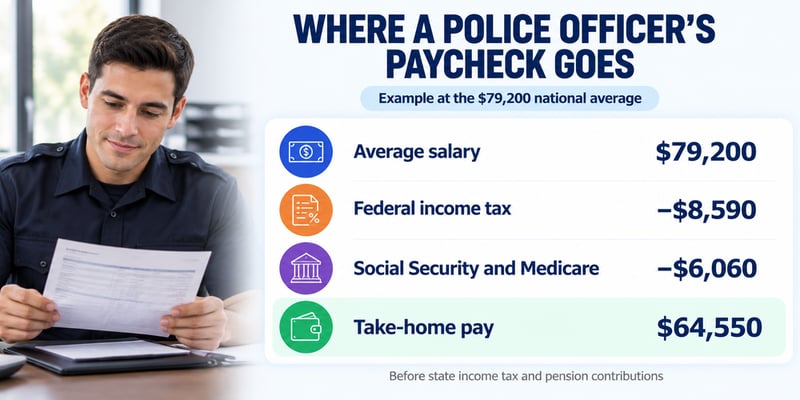
As a worked example, take a single filer earning the $79,200 national average in 2026. After the $16,100 standard deduction, federal income tax under the 2026 rates in IRS Revenue Procedure 2025-32 comes to about $8,590. Social Security and Medicare taxes at 7.65% take about $6,060 more, leaving about $64,550. That example leaves out state income tax and pension contributions, which vary by state and department. Officers not covered by Social Security do not pay the 6.2% Social Security tax.
Best states for cost-adjusted police pay
State | Avg. Salary | Price Index | Adjusted Value |
|---|---|---|---|
California | $112,980 | 110.7 | $102,040 |
Alaska | $101,770 | 102.4 | $99,420 |
Washington | $104,140 | 107.0 | $97,320 |
Delaware | $93,210 | 99.8 | $93,390 |
Illinois | $92,450 | 100.0 | $92,490 |
Colorado | $90,550 | 103.1 | $87,870 |
Iowa | $76,280 | 87.8 | $86,920 |
Nevada | $86,470 | 100.0 | $86,490 |
Minnesota | $85,130 | 98.6 | $86,320 |
New Jersey | $93,700 | 108.8 | $86,120 |
The price index is the BEA 2024 regional price parity for all items, where the US equals 100. Adjusted values are calculated from May 2025 BLS averages. Iowa, which ranks outside the top 10 for pay, moves to seventh after adjusting for prices.
Job Outlook
BLS growth projection and annual openings
The BLS employment projections show employment of police and sheriff's patrol officers growing 3.5% from 2025 to 2035, from about 693,200 jobs to 717,300, the same rate projected for all occupations. BLS expects about 51,500 openings a year, many of them to replace officers who move to other occupations or retire.
Trends shaping demand
BLS notes that even when crime rates fall, demand for police services to maintain public safety is expected to continue. Staffing shortages, retention bonuses, recruitment campaigns and new technology vary by department, and BLS does not publish national figures on them.
How to Increase Your Police Officer Salary
Earn a degree or certifications
A degree can add incentive pay in some states, such as Florida's monthly education incentive, and BLS notes that a bachelor's degree may be required for lieutenant or higher. Some federal agencies also require college coursework or a degree.
Pursue promotion and specialty units
Sergeants and lieutenants in local departments, whom BLS counts together, averaged $109,170, about $30,710 more than local patrol officers. Detectives in local government averaged $83,000. Promotion usually depends on exam scores and performance after probation.
Move to a higher-paying department or state
California, Washington and Alaska average more than $100,000, and California metros such as San Jose and San Francisco top $130,000. State police average $92,010, compared with $78,460 in local departments. Check each state's POST rules before moving, since certification may not transfer automatically.
Use overtime and secondary employment wisely
Overtime pays at least time and a half once an officer passes the threshold for the work period, and five extra hours a week at the national average adds about $14,850 a year. Approved off-duty details can add more, within department limits.
Frequently Asked Questions
How much does a police officer make per year?
Police and sheriff's patrol officers earned an average of $79,200 a year in May 2025, according to BLS, and the median was $76,210. The lowest-paid 10% earned under $47,510, and the top 10% earned more than $115,120. Overtime and incentive pay can raise yearly earnings above these base figures.
How much does a police officer make per hour?
The average police officer hourly wage was $38.08 in May 2025, and the median was $36.64. State averages ranged from $22.60 an hour in Mississippi to $54.32 in California. Overtime is paid at time and a half once an officer passes the threshold for the department's work period.
What is the average police officer salary in the US?
The average police officer salary in the US was $79,200 a year, or $38.08 an hour, in May 2025, based on BLS data for about 670,520 police and sheriff's patrol officers. The median, which is less affected by high earners, was $76,210 a year.
How much do police officers make when they start?
Starting pay depends on the department. The NYPD's 2026 exam notice lists a minimum salary of $55,942, and the LAPD's pay ranges start at $93,730 and $97,363. Nationally, the lowest-paid 10% of police officers earned under $47,510 in May 2025.
How much do police officers make in their first year?
First-year pay is usually the department's starting step. BLS does not publish pay by experience, but the 10th percentile was $47,510 and the 25th percentile $59,290 in May 2025. Large departments pay more, such as the NYPD's $55,942 minimum and the LAPD's $93,730 starting rate.
Which state pays police officers the most?
California pays police officers the most, with an average of $112,980 a year, or $54.32 an hour, in May 2025. Washington followed at $104,140 and Alaska at $101,770. California stays first even after adjusting for its prices, which are the highest of any state.
Which state pays police officers the least?
Mississippi pays police officers the least, with an average of $47,010 a year, or $22.60 an hour, in May 2025. Arkansas followed at $49,850 and Louisiana at $51,250. Prices in these states are well below the US average, which narrows the gap in real pay.
How much do police detectives make?
Detectives in local government earned an average of $83,000 a year, or $39.90 an hour, in May 2025. Across all employers, detectives and criminal investigators averaged $99,430, a figure raised by federal agents, who averaged $127,760. BLS notes that in large departments, officers may be promoted to detective.
How much do police sergeants make?
BLS counts sergeants with first-line supervisors of police and detectives. In local government, that group averaged $109,170 a year, or $52.49 an hour, in May 2025. Across all employers, the average was $112,190, and the top 10% earned more than $165,110.
How much do state troopers make?
Police officers employed by state governments, which include state troopers and highway patrol officers, earned an average of $92,010 a year, or $44.24 an hour, in May 2025. That is about $13,550 more than the $78,460 average for officers in local departments.
How much do federal police officers make?
Federal police officers in the BLS patrol officer occupation averaged $79,390 a year in May 2025. Federal criminal investigators, such as FBI agents and deputy US marshals, averaged $127,760. Criminal investigators also receive availability pay of 25% of basic pay, according to OPM.
Do police officers get paid overtime?
Yes. BLS reports that paid overtime is common for police. Under federal rules, public agencies can use a special work period for law enforcement, with overtime due after 171 hours in 28 days or a proportional amount for shorter periods. Overtime pays at least time and a half.
Can police officers make six figures?
Many do. The top 10% of police officers earned more than $115,120 in May 2025, and California, Washington and Alaska average over $100,000. Sergeants and lieutenants in local departments averaged $109,170, and the NYPD's schedule reaches $109,352 after five and a half years.
How much do police chiefs make?
BLS does not publish a separate figure for police chiefs. Their pay is set by each city, county or department and depends heavily on department size. For comparison, the top 10% of first-line supervisors of police and detectives earned more than $165,110 in May 2025.
Do police officers get a pension?
State and local police pension plans are run by a city, county or state, with terms that vary by plan. Federal law enforcement officers can retire at 50 with 20 years of service, or at any age with 25 years. Some officers also pay into Social Security.
How much do police academy recruits get paid?
Recruit pay is set by each department, and some departments hire only certified academy graduates. The NYPD's 2026 exam notice lists a minimum salary of $55,942, and the LAPD's pay ranges start at $93,730 and $97,363. No government source publishes a national recruit figure.
Does a college degree increase a police officer's salary?
It can. Florida pays officers $30 a month for a community college degree and an additional $50 for a bachelor's degree under state law. BLS notes that a bachelor's degree may be required for promotion to lieutenant or higher, and some federal agencies require a degree.
How much do police officers make in California, Texas and New York?
In May 2025, police officers averaged $112,980 a year in California, $76,160 in Texas and $87,110 in New York, according to BLS. California ranks first among the states, New York tenth. Texas employs about 63,100 officers, close to California's 65,940.
Is being a police officer a good career?
It offers above-average pay for an entry requirement of a high school diploma: the $76,210 median is higher than the $50,980 median for all occupations. BLS projects 3.5% job growth from 2025 to 2035, with about 51,500 openings a year. The work can be stressful and dangerous.
How do police officer salaries compare to correctional officer salaries?
Police and sheriff's patrol officers earned a median of $76,210 in May 2025, about $17,270 more than the $58,940 median for correctional officers and jailers. Police employment is projected to grow 3.5% from 2025 to 2035, while correctional officer jobs are projected to decline.
Comparing Police Officer Pay by State, Rank and Department
The average police officer earns $79,200 a year, or $38.08 an hour, and the middle 80% of officers earn between $47,510 and $115,120. California, Washington and Alaska average more than $100,000, while Mississippi averages $47,010. How much a police officer makes in a given job depends on location, rank and department: promotion to sergeant or lieutenant, a move to state police, or a high-paying metro can raise pay well above the national figure. Overtime, incentive pay, pensions and benefits add more on top of base salary. Dreambound helps people compare training programs for law enforcement and related careers. Wage figures come from the BLS Occupational Employment and Wage Statistics survey for May 2025 unless another source is named.
Police Officer Salary by State (Full Table)
# | State | Avg. Annual Salary | Avg. Hourly Wage | Rank |
|---|---|---|---|---|
1 | Alabama | $55,130 | $26.51 | 47 |
2 | Alaska | $101,770 | $48.93 | 3 |
3 | Arizona | $81,720 | $39.29 | 17 |
4 | Arkansas | $49,850 | $23.96 | 49 |
5 | California | $112,980 | $54.32 | 1 |
6 | Colorado | $90,550 | $43.54 | 7 |
7 | Connecticut | $83,920 | $40.35 | 13 |
8 | Delaware | $93,210 | $44.81 | 5 |
9 | Florida | $75,320 | $36.21 | 24 |
10 | Georgia | $58,520 | $28.14 | 45 |
11 | Hawaii | $90,360 | $43.44 | 8 |
12 | Idaho | $70,860 | $34.07 | 28 |
13 | Illinois | $92,450 | $44.45 | 6 |
14 | Indiana | $75,130 | $36.12 | 26 |
15 | Iowa | $76,280 | $36.67 | 22 |
16 | Kansas | $61,450 | $29.55 | 41 |
17 | Kentucky | $59,840 | $28.77 | 44 |
18 | Louisiana | $51,250 | $24.64 | 48 |
19 | Maine | $69,830 | $33.57 | 33 |
20 | Maryland | $82,400 | $39.62 | 15 |
21 | Massachusetts | $83,230 | $40.01 | 14 |
22 | Michigan | $70,310 | $33.80 | 32 |
23 | Minnesota | $85,130 | $40.93 | 12 |
24 | Mississippi | $47,010 | $22.60 | 50 |
25 | Missouri | $62,520 | $30.06 | 39 |
26 | Montana | $69,540 | $33.43 | 34 |
27 | Nebraska | $75,290 | $36.20 | 25 |
28 | Nevada | $86,470 | $41.57 | 11 |
29 | New Hampshire | $70,630 | $33.96 | 29 |
30 | New Jersey | $93,700 | $45.05 | 4 |
31 | New Mexico | $66,700 | $32.07 | 36 |
32 | New York | $87,110 | $41.88 | 10 |
33 | North Carolina | $61,390 | $29.51 | 42 |
34 | North Dakota | $72,400 | $34.81 | 27 |
35 | Ohio | $76,730 | $36.89 | 20 |
36 | Oklahoma | $63,120 | $30.34 | 38 |
37 | Oregon | $87,990 | $42.30 | 9 |
38 | Pennsylvania | $81,910 | $39.38 | 16 |
39 | Rhode Island | $78,760 | $37.86 | 18 |
40 | South Carolina | $60,420 | $29.05 | 43 |
41 | South Dakota | $64,320 | $30.93 | 37 |
42 | Tennessee | $61,830 | $29.72 | 40 |
43 | Texas | $76,160 | $36.62 | 23 |
44 | Utah | $78,760 | $37.87 | 19 |
45 | Vermont | $70,560 | $33.92 | 30 |
46 | Virginia | $70,450 | $33.87 | 31 |
47 | Washington | $104,140 | $50.07 | 2 |
48 | West Virginia | $55,900 | $26.88 | 46 |
49 | Wisconsin | $76,560 | $36.81 | 21 |
50 | Wyoming | $67,080 | $32.25 | 35 |
51 | District of Columbia | $92,390 | $44.42 | Not ranked (not a state) |
Figures are BLS May 2025 averages for police and sheriff's patrol officers (SOC 33-3051). Rank is by average annual salary among the 50 states; the District of Columbia is shown but not ranked.